Several years ago, I had the privilege of spending Palm Sunday in a country that follows the Julian calendar, so it was Easter Sunday here in the US, since we follow the Gregorian calendar. The sounds and images of that day are indelibly fixed in my mind.
More than 1,500 people gathered in and around that church, which in our nation would house about 350 people. In the lower auditorium men filled the pews on the right-hand side. They stood back-to-back and shoulder-to-shoulder on the right and center aisles. The women sat on the left and crowded in the left aisle and front. The small balcony was packed with men and women sitting and standing together. Even the pianist and pastor on the small platform had very little room. Worshippers crowded outside around the open windows on both sides and in the street in front of the church.
The people celebrated with waving of palms and exuberant music. Although I didn’t understand their language, I had no problem sensing the earnestness and joy of their singing and worship. Awesome! I recognized a couple of the songs by the melodies and joined in singing in English.
This was not in a country that enjoys religious liberty or freedom in worship. Christians there are not esteemed but are at times considered as outcasts and are often refused jobs and positions of status. For many of these believers, accepting Christ as Savior meant rejection from family and friends. It was evident on that Palm Sunday that they did not regret the suffering and shunning. Their dedication reminds me today of the Apostle Paul’s words in Philippians 3:8: “I count everything as loss because of the surpassing worth of knowing Christ Jesus my Lord. For his sake I have suffered the loss of all things and count them as rubbish, in order that I may gain Christ.”
As we are isolated from each other this weekend  and are celebrating the resurrection of Christ in our homes because of COVID-19, may we be grateful for the privileges we have to worship in freedom. May this time of prayer and praise alone remind us that many believers around the world meet in small groups weekly to avoid identity and prosecution. Our Easter celebration may be vastly different this year, but we can still joyfully celebrate our risen Lord.
As believers in the Early Church said, “He is risen. He is risen indeed.”
 alcohol consumption and lack of exercise.” Alarming!
 Set aside time for Sabboth rest.
 idicule or accusations. But we also believe that God gives wisdom to doctors, researchers, and scientists. When we need a physical miracle, we consult God first and then ask God to lead us to a good physician who can answer our questions and help us explore a solution.


 The stages of grief—denial, anger, bargaining, depression, and acceptance—have been studied and written about for nearly four decades. Now David Kessler, an authority on grief, and famed psychiatrist Elizabeth Kuber-Ross are including a sixth stage—finding meaning—in their new book, which will be released this September. The book will share the benefits of remembering our spouse with more love than pain. I’m sure it will help us to understand the grief process more.
 e sick, and his illness radically changed our present and our future. In many ways, I had denied my emotional pain while dealing with his physical challenges. This helped me survive all of those years of struggle, but now the pain had to be faced.
 g comment, or comical laugh, but they were listening even at the most inopportune moments.
 s and me the importance of God’s Word and the church. Both were musicians and gave us an appreciation for music. But my sisters and I agree that Mom gave us a love for cooking, nice clothes, flowers, and books. We miss her and still honor her in our thoughts. But since dementia marred her last few years, we are glad she is in heaven and completely well.
 st acknowledge that this day does not bring joy for everyone.
 Of course, the Internet had some interesting information. I learned that, although the male robin helps to collect the materials, the female robin weaves together most of the 350 twigs and grasses that are about 6 inches long. These are held together with hundreds of beakfuls of mud. What a construction project! The birds did not attend college classes on architecture. They can’t read a blueprint or write a “how to” manual for the next generation of robins either. I knew that only our Creator God gave the birds this instinctive ability.
 as widows we face many, Scriptures that give us direction, strength, help, wisdom, courage, and even protection will come to our minds to replace fear, worry, doubt, and anxiety.
 the King James Version of the Bible, I learned “For nothing is impossible with God.” One of the more modern translations says, “For no word from God will ever fail” (NIV). All we need to do is to look at the historical record to prove that this is true concerning the birth of Christ.
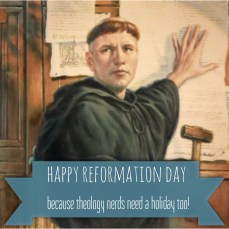 e castle church door in Wittenberg, Germany. His declaration began the debate that would become the Protestant Reformation.